


Pancho and Lefty and Malachi (VIDEO)
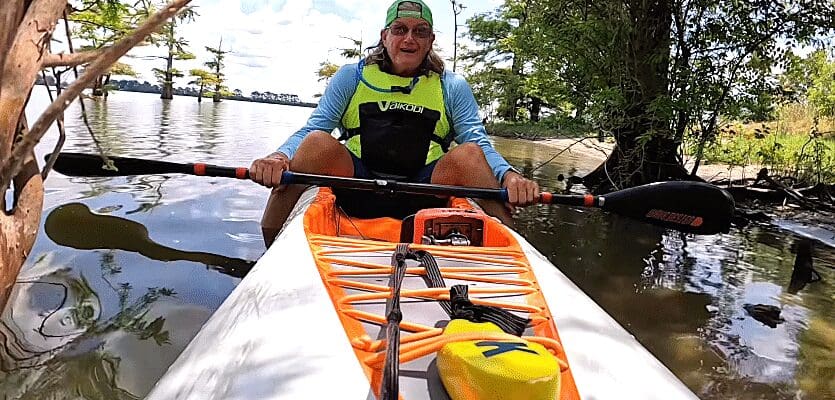
Hey, man. This is Chilly Billy Howell. Yesterday, I shared the song “Pancho and Lefty” by Townes Van Zandt, while I was paddling. Some people think I’m really into music, and I’m really not. When driving in the car, I usually drive without music. When I paddle, I never listen to music, just because I like the sounds of nature, but I always put a song to my GoPro videos afterwards. Adding music makes it more palatable for me to evaluate my stroke when I watch the video afterwards.
Plus, you know, some people can go to concerts and big venues and listen to music all day. I just can’t. I am so sensitive, one song can wear me out; it’s not because I’m deeper than other folks, I’m just, I guess, more fragile. So, I have to be careful with my relationship with music. When I do listen to music, I just dive into whatever I dive into, and I dove into Townes Van Zandt and his “Pancho and Lefty” the last few days.
When I’m gonna talk or share something I usually begin with a title, and then come up with the content. Most people come up with the content, and an editor or publisher writes the title. But if I had to title this rambling, it’d be “Pancho, Lefty, and Malachi.”
I’m a poor poet, a poor writer, but I write, so that makes me a poet and a writer, because I do it; whether it’s what folks would qualify as good is debatable. I’m finally figuring out that in writing, I get stuff out of my head and heart, and then in sharing it, I can put it to rest. So, whatever that’s worth.
Lately, I really dug into “Pancho and Lefty” by Townes Van Zandt. The alienation and complexity and brilliance of Townes Van Zandt’s “Pancho and Lefty” leaves me feeling sad, lonely and empathetic; it’s a poet’s soul bared. I was turned onto Townes Van Zandt when I lived out west, but I didn’t dig it because I didn’t understand it. I probably didn’t understand him because I hadn’t had been beat up and scarred enough to understand him.
He was a Texas Troubadour, brilliant, introspective, troubled, and “Pancho and Lefty” said just came to him. He didn’t really understand it, nor can we, but we can feel it. I have a lot of empathy for Townes now that I’ve really dug into his life. He and I suffered a lot of the same addictions, a lot of the same internal, mental conundrums. He went through a lot of electric shock therapy that really should make anybody empathetic to what became of him, but he still was brilliant in how he bared his soul.
There are many types of literary criticism, and literary criticism is how we analyze and interpret literature. I really engage “Pancho and Lefty,” which is a classic, from what one would call a reader-response perspective, an author-bio perspective, and maybe a mythological critique perspective. That’s just kinda how it makes me feel, even if I don’t fully understand it. And, again, he didn’t fully understand it.
I resemble somewhat his tortured soul. The difference is he and I both delved into alcohol and drugs and everything else to try to feel normal or deal with whatever ailed us. The difference is it got him, and, thankfully, I’ve had a late life redemption and now have hope that maybe he just couldn’t get hold of. Anyway, I’m ready to put this to rest; I’ve been digging into it, and it has really kinda depressed me.
Now, I’m ready to move on to more healing and hope. Pancho and Lefty is a myth, and my nom de plume I write under, Malachi Montroy, is mythological. Myths can sometimes interpret life in ways that help us to understand reality, yet they are just that. They’re a myth.
G.K. Chesterton, who I love, wrote a lot about myths. He said a myth is a work of the imagination, and therefore, it’s a work of art. It needs a poet to criticize it. He further states that the poet feels the mystery of the forest, not the science of it. For me, it’s like being on the water, I feel the beauty of being on the water, even if I don’t understand everything about it clinically or scientifically. Mythology is just really a search.
I don’t expect many, if any, people to fully understand the particulars and universals with my “Wrestling with Wisdom at the Crossroads: The Aphorisms and Poems of Malachi Montroy,” the book we are about to publish, but I am compelled to share them regardless of the reception.
Townes Van Zandt’s unavoidable, yet ably expressed melancholy kinda crawls across my cerise scars like a reptile’s belly on silk. It really does. His music, his poems, and the way he articulates them resonates with who I was, but not who I wanna be.
Please comment and share and subscribe.